Wednesday, 27 September 2017
Dark Skies Workshop © F.O.B./ Robert Ince
Video © Robert Ince
The Forest of Bowland A.O.B http://www.forestofbowland.com/Star-Gazing is one of the few dark sky areas in Britain where light pollution is at a minimum so it is a perfect place to go stargazing and within this area there are 4 sites to choose from, the nearest being Crook O'Lune near Caton . The others are Beacon Fell Country Park, Slaidburn and Gisburn Forest Hub where this workshop took place. Incidentally, Gisburn Forest by day is a fantastic place to explore by bike with all the forest trails available. There's one more star gazing site that is nearer to home: Roeburndale just up from the cottage or Roeburndale West at the cattle grid where a 180° view of the night sky can be seen. For a list of Robert Ince's stargazing workshop He is also available for booking an event.
For more details about Dark Sky Discovery Sites here is the website

Friday, 4 August 2017
Doing Our Bit for Nature
The natural world needs our help so at Roeburnscar, we try to garden with nature in mind. That means not mowing,
 weeding, tidying etc. as much as possible. We have put a small insect hotel in the flat garden,
 we leave brushwood piles
 around for small mammals and insects to hide in and they will eventually rot down creating another beneficial environment for soil microbes. Small mown patches
 help insects that like smaller grasses and we leave mowing if the lawn has clover growing in it as bees love it. We don't like to kill wasps as they are beneficial to pollination so the waspinators you see hanging around are pretend hornet nests and hopefully deter wasps from settling in the wooden outside of the house.


Saturday, 20 May 2017
From Tree to Door
Some of the lovely conifers that were a potential hazard in fierce gales re the cottage roof had to be felled. Rod's father planted them in the early 1960's. We are putting the timber to good building use starting by replacing the old hardboard doors in the cottage with lovely pine ones.
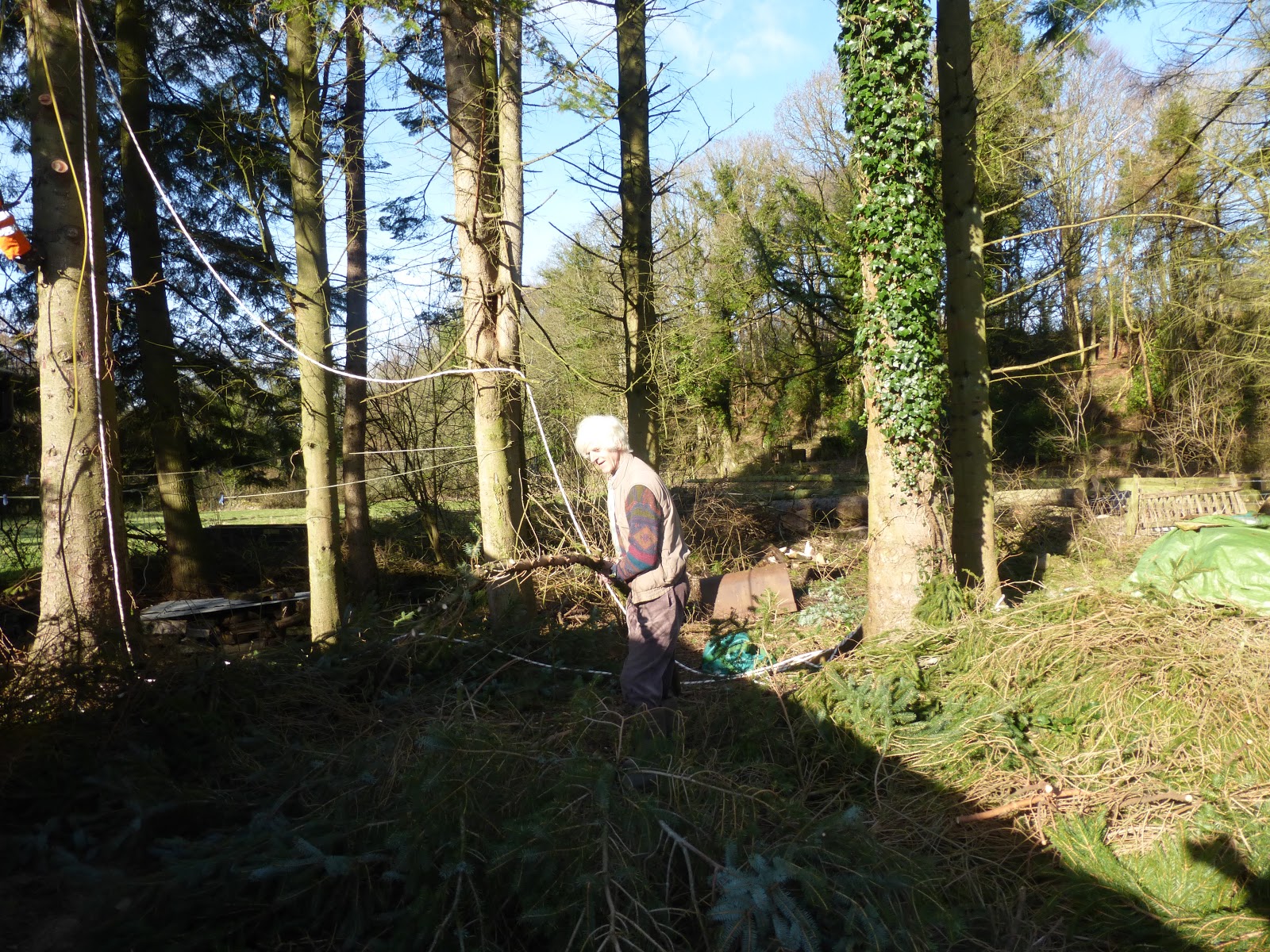 |
| Rod preparing tree felling |
 |
| felled trees with Roeburnscar in the backgound |
 |
| back of laundry shed -the trees have gone now |
 |
| Ben up a tree removing branches before felling |
 |
| the beauty in a tree slice |
 |
| felled tree |
 |
| the logs are taken from Roeburnscar to the saw bench on the farm |
 |
| storing the planks with wedges in between to season the timber in the solar wood store drier |
 |
| Ben pondering the task ahead |
 |
| one of the almost finished doors |
 |
| kitchen door in place showing the beauty of the grain |
Saturday, 18 February 2017


Monday, 13 February 2017
Forest of Bowland Raptor Persecution
Classified as an Area of Outstanding Natural Beauty, it covers 808 square Kilometers of rural Lancashire and North Yorkshire.
The Forest of Bowland is internationally important for its upland bird populations and under the Habitats Directive "Bowland Fells" are designated a Special Protection Area for specific birds of prey.
The Forest of Bowland may be an SPA, but raptors like Hen Harrier and Peregrine Falcon receive no protection.
In 2009 - 25 Peregrine territories in the Forest of Bowland were examined by the NWRG. 17 sites were occupied, 6 nests failed following the loss of eggs, chicks and adult birds. A total of 11 territories produced 24 fledged young.
In 2010 the Government’s Wildlife Adviser, Natural England, withdrew Peregrine licenses for use in the Forest of Bowland from members of the NWRG, following the group’s disclosure on social media of wide scale raptor persecution throughout this moorland region, where Red Grouse are shot. Other licenses issued to group members since 1974, covering additional raptor species including Peregrine for areas outside the Forest of Bowland remained unaffected.
By 2016, 99% of Bowland Peregrine nesting territories were found abandoned.
The loss of an entire regional population of Peregrines (18 pairs) from the Forest of Bowland is unprecedented.
To protect these Peregrines, the NWRG need your help to purchase the following urgently needed kit: Go-Pro camera - 2 mountain bikes - radio transceivers & infra-red night vision goggles.
Throughout the last 43 years members of the North West Raptor Group have self-funded their work.
If the killing of Peregrines continues, they will be lost forever, not only from the Forest of Bowland but also from the rest of England's northern uplands, where Red Grouse are shot for sport.
Help spread the word!
Wednesday, 25 January 2017
Crowdfunding appeal for new raptor satellite tag project © R.P.U.K.
The campaign group Birders Against Wildlife Crime has launched a crowdfunding appeal to help support a new project to fit satellite tags to raptors in northern England, set to begin later this year.
Satellite tagging has revolutionised efforts to detect raptor persecution crimes, and has also helped draw public attention to the illegal killing of raptors. The power of satellite-tagging was really first realised in 2009 when a young satellite-tagged golden eagle, ‘Alma’, was found dead on a grouse moor on the Millden Estate in the Angus Glens. She’d been poisoned. It’s highly unlikely her corpse would have been detected had she not been fitted with a satellite tag, which allowed investigators to pinpoint her body as she lay face down in a vast expanse of heather moorland. The resulting publicity about her death was phenomenal, and even though nobody was ever prosecuted, this crime turned the spotlight on to an industry that had escaped scrutiny for so long.

Since Alma, there have been many other illegally-killed raptors, including golden eagles, white-tailed eagles, hen harriers, Montagu’s harriers and red kites whose satellite tags have given the game away. These days, the raptor killers are wise to the game and now it’s far more common for a sat-tagged bird to simply ‘disappear’, with all the evidence (carcass, sat tag) simply destroyed to avoid detection, although occasionally there won’t be a ‘clean kill’ and the wounded bird is able to move some distance before succumbing to its injuries and investigators are able to collect the corpse, conduct a post mortem and record it as a confirmed persecution crime.
Some within the grouse-shooting industry have recently been trying to discredit the use of raptor satellite tags, and it’s not hard to see why. They’ve slurred the professional reputations of highly experienced and licensed raptor researchers and have used some photographs of a young golden eagle with what appears to have a ‘slipped’ tag harness as evidence that the tagging experts don’t know what they’re doing. Now, of course, it’s possible for a sat tag harness to slip, and it does happen on occasion, but it’s a rare occurrence. What the accusers don’t mention is the circumstantial evidence that suggests tagged raptors are being caught inside crow cage traps, providing an opportunity for the trap operator to cut one of the harness straps before releasing the bird, with its tag now dangling and looking like it has been badly fitted. There is also evidence of at least one tagged hen harrier being trapped, its harness removed and transferred to a free-ranging corvid, presumably with the intention of disguising the fact the hen harrier was illegally killed.
Strangely, the grouse shooting industry has not tried to vilify the satellite tagging of non-raptor species, such as woodcock (GWCT project) or cuckoos (BTO project); it’s only the tagging of raptors they seem to object to. Can’t think why.
Here’s a photo (taken by Stephen Murphy) of Bowland Betty, a sat-tagged hen harrier found dead on a grouse moor on the Swinton Estate in Yorkshire in 2012. A post mortem revealed she had been shot.

The new raptor satellite-tagging project in northern England is being undertaken by highly experienced and licensed experts in an independent research consortium (all voluntary – no salaries are being paid). The beauty of this independence is that sat tag data will be put in to the public domain very, very quickly. No more waiting for weeks/months/years to find out what happened, which will allow timely and targeted publicity every time one of these raptors ‘disappears’ or is found shot/trapped/poisoned. Greater public awareness of raptor persecution is key to bringing it to an end.
The crowdfunding target is to reach £10,000 by mid-March. It’s ambitious but it’s do-able. If you’d like to make a donation, however small or large, please visit BAWC’s crowdfunding page HERE
Thank you
Satellite tagging has revolutionised efforts to detect raptor persecution crimes, and has also helped draw public attention to the illegal killing of raptors. The power of satellite-tagging was really first realised in 2009 when a young satellite-tagged golden eagle, ‘Alma’, was found dead on a grouse moor on the Millden Estate in the Angus Glens. She’d been poisoned. It’s highly unlikely her corpse would have been detected had she not been fitted with a satellite tag, which allowed investigators to pinpoint her body as she lay face down in a vast expanse of heather moorland. The resulting publicity about her death was phenomenal, and even though nobody was ever prosecuted, this crime turned the spotlight on to an industry that had escaped scrutiny for so long.
Since Alma, there have been many other illegally-killed raptors, including golden eagles, white-tailed eagles, hen harriers, Montagu’s harriers and red kites whose satellite tags have given the game away. These days, the raptor killers are wise to the game and now it’s far more common for a sat-tagged bird to simply ‘disappear’, with all the evidence (carcass, sat tag) simply destroyed to avoid detection, although occasionally there won’t be a ‘clean kill’ and the wounded bird is able to move some distance before succumbing to its injuries and investigators are able to collect the corpse, conduct a post mortem and record it as a confirmed persecution crime.
Some within the grouse-shooting industry have recently been trying to discredit the use of raptor satellite tags, and it’s not hard to see why. They’ve slurred the professional reputations of highly experienced and licensed raptor researchers and have used some photographs of a young golden eagle with what appears to have a ‘slipped’ tag harness as evidence that the tagging experts don’t know what they’re doing. Now, of course, it’s possible for a sat tag harness to slip, and it does happen on occasion, but it’s a rare occurrence. What the accusers don’t mention is the circumstantial evidence that suggests tagged raptors are being caught inside crow cage traps, providing an opportunity for the trap operator to cut one of the harness straps before releasing the bird, with its tag now dangling and looking like it has been badly fitted. There is also evidence of at least one tagged hen harrier being trapped, its harness removed and transferred to a free-ranging corvid, presumably with the intention of disguising the fact the hen harrier was illegally killed.
Strangely, the grouse shooting industry has not tried to vilify the satellite tagging of non-raptor species, such as woodcock (GWCT project) or cuckoos (BTO project); it’s only the tagging of raptors they seem to object to. Can’t think why.
Here’s a photo (taken by Stephen Murphy) of Bowland Betty, a sat-tagged hen harrier found dead on a grouse moor on the Swinton Estate in Yorkshire in 2012. A post mortem revealed she had been shot.
The new raptor satellite-tagging project in northern England is being undertaken by highly experienced and licensed experts in an independent research consortium (all voluntary – no salaries are being paid). The beauty of this independence is that sat tag data will be put in to the public domain very, very quickly. No more waiting for weeks/months/years to find out what happened, which will allow timely and targeted publicity every time one of these raptors ‘disappears’ or is found shot/trapped/poisoned. Greater public awareness of raptor persecution is key to bringing it to an end.
The crowdfunding target is to reach £10,000 by mid-March. It’s ambitious but it’s do-able. If you’d like to make a donation, however small or large, please visit BAWC’s crowdfunding page HERE
Thank you
Saturday, 12 November 2016
© Mark Avery's Report about The Debate
The ‘debate’ – some first thoughts
![By Adrian Pingstone (talk · contribs) (Self-photographed) [Public domain], via Wikimedia Commons](http://markavery.info/wp-content/uploads/2016/08/799px-Houses.of_.parliament.overall.arp_.jpg)
By Adrian Pingstone (talk · contribs) (Self-photographed) [Public domain], via Wikimedia Commons
- Steve Double MP (he who thinks the Badger is the UK’s largest rodent) behaved appallingly as the MP chosen from the Petitions Committee to introduce the debate. His role might have been to signal that this was a subject of considerable interest but not to parade his uninformed views which were basically saying ‘The people who signed this e-petition are wrong’. I would have no problem with him expressing that view as an individual MP, but not in his role as a Petitions Committee member introducing a subject brought to Parliament by a large number of people. Mr Double was disrespectful of the process and of those who signed the e-petition and he ought to be ashamed of himself. I will come back to this.
- Charles Walker MP, is a very impressive speaker in terms of delivery but traduced my views in his speech. As a holder of a degree in political science he might, perhaps, consider that he is inexpertly qualified to speak quite so dogmatically about science and he was one of several MPs (all Conservative MPs in favour of driven grouse shooting) who referred to me as Mr Avery when in this particular context it might have been more appropriate to recognise my doctorate in science (and a reasonably impressive publication record too). I will come back to this too.
- The Conservative shooters turned out in very strong numbers including the Chair of the Countryside Alliance, Simon Hart; the chair of the APPG on Shooting (and Conservation ha ha), Geoffrey Clifton-Brown; grouse moor owner and GWCT trustee, Richard Benyon; the former director of public affairs for the British Field Sports Society, Nick Herbert; and last, and obviously not least, the disrespectful Nicholas Soames.
- There were no Liberal Democrats MPs present in the Hall at any time through the 3-hour debate (unless I missed them – do tell if I did) and none made a contribution to the debate despite Liberal Democrat constituencies (and ex-constituencies of which there are many more) being strong supporters of the e-petition.
- The SNP were thin on the ground despite Scotland producing a stronger than average support for the e-petition. Let me thank Richard Arkless for making two useful interventions in the debate (and may I thank several of his constituents for encouraging him to take part in the debate) and Lisa Cameron for one and Margaret Ferrier for attempting three times (rather than the one recognised in the transcript) to intervene in the Minister’s closing remarks. Having thanked those three, it was a poor show overall from the SNP who had the ability to make a speech in the closing and passed this up. The Scottish experience, particularly in respect of vicarious liability ought to have been part of this UK debate. If I had a SNP MP I would feel short-changed.
- The Labour Party, of which I am a member, was also thin on the ground. Many thanks to those who turned up and most especially to Rachael Maskell and Kerry McCarthy for their excellent efforts. Angela Smith did quite well but lacks the killer instinct in these debates and as the Hen Harrier Champion might have been expected to get stuck in rather more on their behalf. It was good to see one of the ‘Sodden 570’, Barry Gardiner MP, attend the early part of the debate although he could not speak as he is a Shadow Minister. Thanks too to Stephen Timms for making several interventions, to Holly Lynch for her intervention and to Stephen Twigg for spending some time in the debate. But where were the Labour scourges of the Establishment in this debate, and where were those with large numbers of signatures in their constituencies and where were those with an interest in nature conservation? It was a disappointing turn-out and one which was remarked upon by many Conservative MPs, who were legion, in tones of surprise. I think the Cosnervative shooters were geared up for a bigger argument, but they were given a very easy time.
- It was good to see Caroline Lucas arrive in the debate and make a couple of interventions and I know she had other pressing engagements which prevented her longer attendance – but if she had spoken, then in the allocated seven minutes she would have wiped the floor with the shooters on the other side. It’s a pity cloning is not yet possible and nor yet is proportional representation – I wonder which we will get first?
- the RSPB got quite a lot of criticism (almost as much as Chris Packham and I did) from the Tory ranks, and a little from Labour too, for failing to have a worked-up rather than talked-up licensing system available. but they also got a fair amount of ill-informed and rather random criticism from the Conservative shooters. After being slagged off the RSPB was exhorted to come back into the fold of the Defra Hen Harrier Inaction Plan – the world is a bizarre place.
- there was a lot of nonsense spoken: mostly by men (although Antoinette Sandbach and Therese Coffey obviously didn’t want to be left out) and mostly by Conservatives. I will come back to this, for sure.
- Several MPs were dismissive, or worse, of the views of those who had, through a process that parliament itself had set up, brought this matter to the ancient confines of the Palace of Westminster. Parliament itself set up this process – it asked the electorate to voice its views through this particular system. And very few subjects, certainly very few as niche in the general scheme of things as driven grouse shooting, get the support necessary for such a debate. The least that might be expected of MPs in such a debate is that they might recognise that the subject is one of concern. I have no issue with Conservatives who shoot piling out in droves to speak against a ban on grouse shooting, but that they did so with such deplorable bad manners when the 123,077 people had brought them to this debate is bringing parliament’s own process into contempt. But at least the Tories turned up!
- the minister’s summing up was as complacent as everything else that has come out of Defra in the last couple of years. No change in policy was signalled. No concern about the current state of affairs was mentioned.
Subscribe to:
Posts (Atom)